Artificial intelligence: a revolutionary tool for discovering archaeological treasures hidden under desert dunes
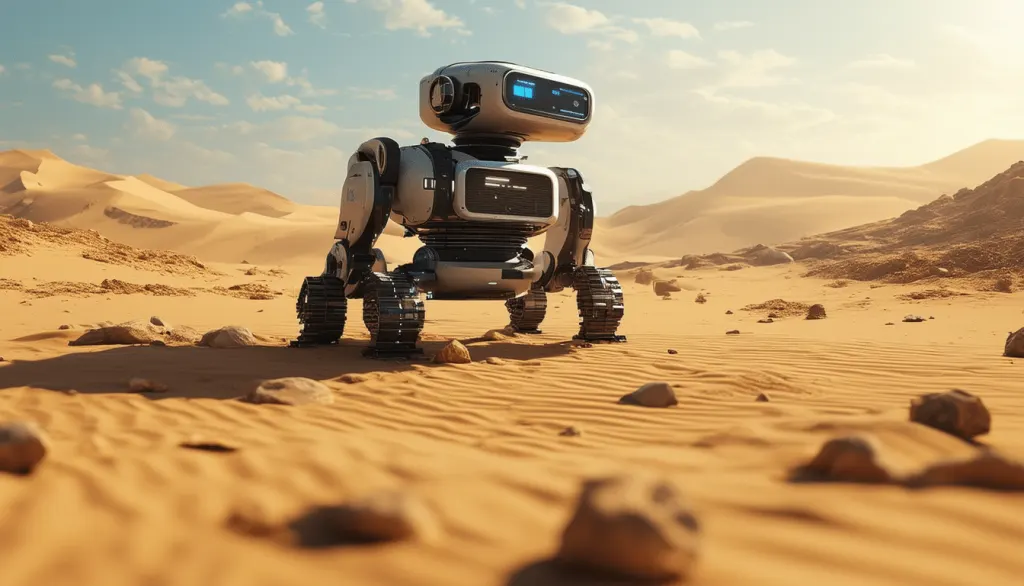
Archaeological research has always been a demanding quest requiring considerable resources and unparalleled precision. Today, technological innovation opens up new perspectives thanks to**artificial intelligence**. Using machine learning algorithms and neural networks allows inaccessible regions to be mapped and analyzed, revealing hidden archaeological treasures under the desert dunes. These revolutionary tools transform traditional methods by making it possible to explore large areas with unprecedented speed and precision.

The combination between artificial intelligence and archeology makes it possible to explore difficult-to-access areas such as deserts, by detecting anomalies under sand dunes. This revolutionary technique offers new perspectives for identifying, analyzing and preserving archaeological sites previously invisible to the human eye.
Traditional methods and their limits
Traditional archeology methods such as on-site excavations, aerial photography and topographical surveys have significant limitations when it comes to detecting structures hidden under thick layers of sand. Deserts, in particular, remain largely unexplored due to the immensity of these territories and the difficult climatic conditions.
Artificial intelligence algorithms at the service of archeology
The power of AI lies in its ability to process and analyze large data sets. In archaeology, algorithms machine learning and of deep learning are used to examine satellite images, LIDAR (Light Detection and Ranging) surveys, and geophysical scans. These algorithms detect patterns and anomalies that human methods cannot perceive.
Analysis of satellite images
Satellite images capture details invisible to the naked eye. By analyzing these images with AI algorithms, researchers can identify subtle variations in the coloring and texture of the sand, suggesting the presence of buried structures. AI makes it possible to sort millions of images in record time, focusing researchers’ attention on areas of particular interest.
The role of LIDAR
THE LIDAR uses laser pulses to measure the distance between the sensor and the ground, creating highly accurate 3D surface models. By analyzing LIDAR data, AI can discover depressions and elevations hidden by dunes, revealing traces of ancient habitations, roads or monuments. This technology is particularly effective in desert areas where climatic conditions have changed the landscape over time.
The contribution of geophysical scans
Geophysical scanning techniques, such as electrical resistivity and magnetometry, provide information about the physical properties of the soil. AI can interpret this data to identify anomalies indicating the presence of buried structures or objects. This avoids costly and invasive excavations by focusing only on promising areas.
Case studies and major discoveries
Several case studies illustrate the effectiveness of AI in archaeology. For example, in the Sahara, researchers used satellite images and deep learning algorithms to discover a complex network of migration routes and prehistoric habitat sites. In Jordan, LIDAR technology, combined with AI, made it possible to map Nabataean tombs hidden under the sand.
Future applications and challenges
The potential applications of AI in archeology are vast. As technologies advance, AI could become even more precise and efficient, making discoveries possible in even more hostile or unexplored environments. However, there are significant challenges to overcome, particularly in terms of data curation, funding and training archaeologists in new technologies.
Artificial intelligence is radically transforming the way we discover and understand our past. By overcoming the limitations of traditional methods, it opens the way to major archaeological discoveries, particularly in the vast desert expanses of the globe.

Notez cet article
Read next
 AI news
Discovering Leonardo Ai: a digital tool with innovative applications! – September 2025
In a world where is infiltrating every aspect of digital creation, a disruptive player is emerging: Leonardo Ai.…
 AI news
Discover the revolutionary radar with artificial intelligence, designed to detect drivers under the influence of alcohol
Currently being tested in Devon and Cornwall, an innovative device uses to identify drivers in a state of weakness due…
 AI news
Discover this revolutionary tool to create free and unlimited AI images: a real favorite!
Are you ready to revolutionize the way you create pictures ? Check out this revolutionary tool which allows you to…
 AI news
Jarvis.ai: the revolutionary tool that changes the lives of content creators
Jarvis.ai is a revolutionary that has changed the lives of content creators. Thanks to its machine learning…