Artificial Intelligence in Education: How Teachers Integrate Philosophical Chatbots and Innovative Dictations
Contents12
The introduction of the**artificial intelligence** (AI) in the educational field opens new educational perspectives. This article explores how teachers use philosophical chatbots and innovative dictations to enrich the learning process and meet the individual needs of students. We will also discuss the implications and challenges related to this integration.
Using Philosophical Chatbots in the Classroom
Chatbots and Philosophy: A New Approach
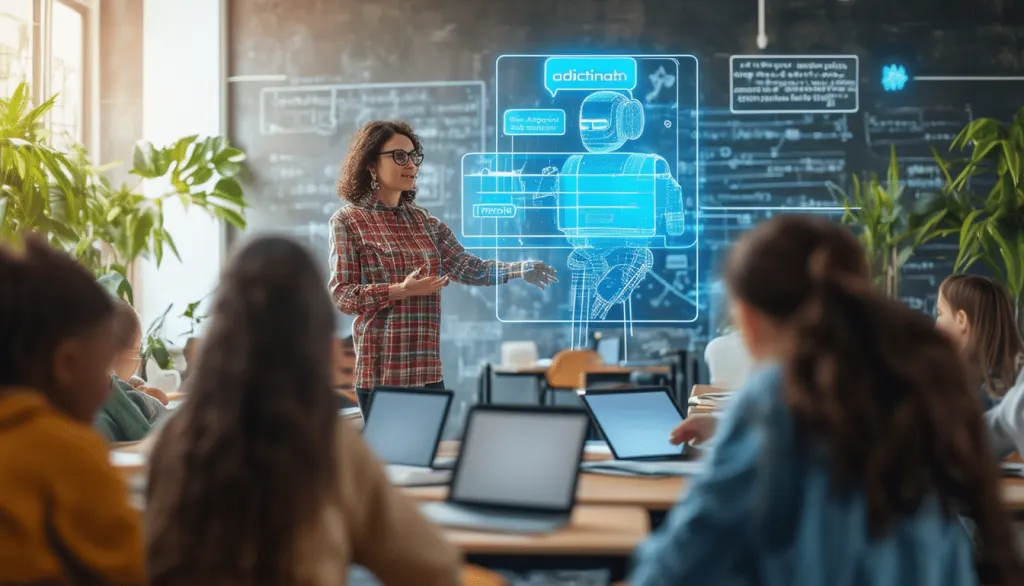
THE philosophical chatbots are designed to simulate complex conversations around philosophical topics. Using advanced natural language processing technologies, these tools allow students to engage with artificial intelligence that can provide thoughtful and thought-provoking responses. This encourages students to think critically and evaluate different points of view.
Concrete Examples of Use
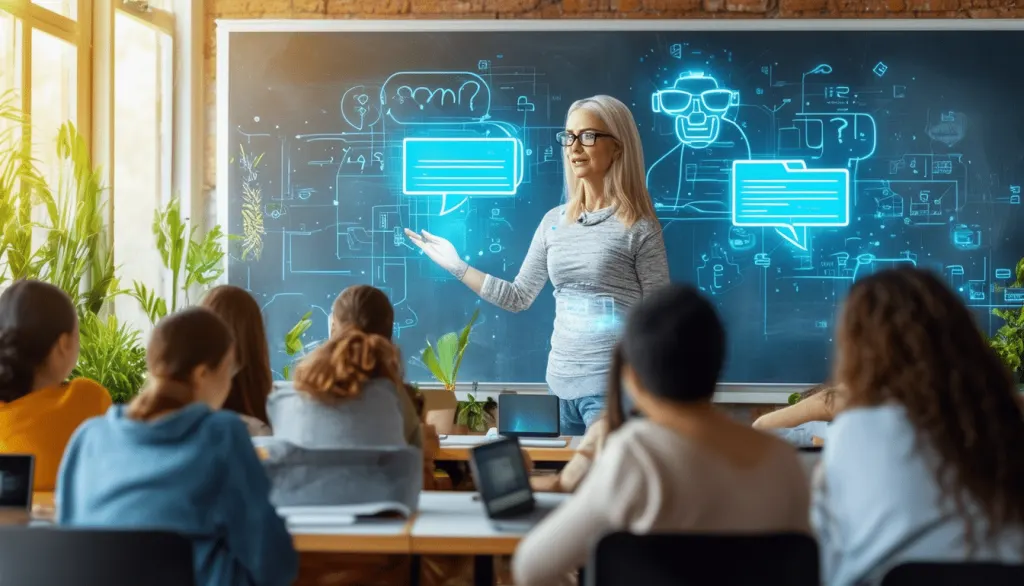
Teachers have integrated conversational agents in their philosophy classes to facilitate class debates. For example, a chatbot can ask students ethical questions, guide them through the arguments of different philosophers, or help clarify complex concepts. This use makes discussions more interactive and dynamic.
Innovative Dictations: A Pedagogical Revolution
What is Innovative Dictation?
THE innovative dictations use artificial intelligence algorithms to create personalized dictation exercises. Unlike traditional methods, these systems adapt the content according to the level and progress of each student, which allows for more targeted and effective learning.
Personalization and Adaptation
Such personalization is made possible thanks to systems of**generative artificial intelligence** which analyze students’ recurring errors and generate sentences specifically designed to target their gaps. This can also include immediate feedback and guidance on grammar, spelling and punctuation, enabling proactive correction and continuous improvement of language skills.
Awareness and Training of Teachers
Awareness Initiatives
In order to help teachers better understand and integrate these new technologies, training programs artificial intelligence awareness are put in place. These initiatives, often led by education and technology experts, aim to provide teachers with the skills needed to fully harness the potential of AI in the classroom.
AI micro-training
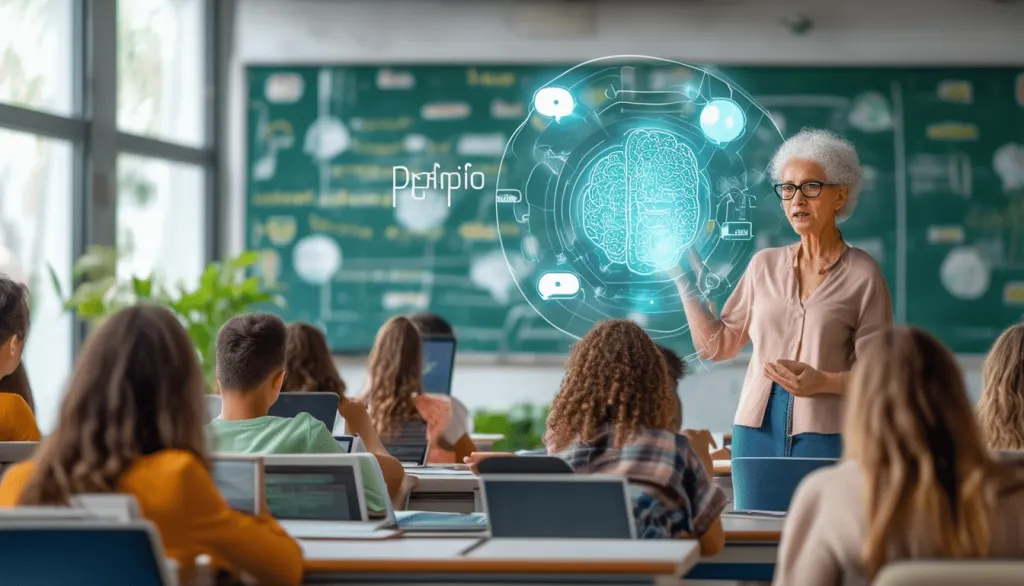
An innovative approach is to use artificial intelligence to train teachers themselves. AI systems can offer micro-training personalized, by providing specific modules on the use of chatbots and innovative dictations, showing them how these tools can be effectively integrated into their teaching practices.
Implications and Challenges of Integrating AI in Education
Support and Automation
Using AI can automate certain repetitive tasks, giving teachers more time to focus on human interaction and pedagogy. However, it is crucial to understand that AI must be seen as a support rather than a substitute for the teacher.
Ethical and Practical Questions
The integration of AI in education also raises many ethical and practical questions. It is essential to guarantee the data privacy students, to prevent algorithmic bias and to ensure that these tools are accessible to all students, regardless of their socio-economic context.
Notez cet article
Read next
 AI news
Education: The rectorate of the Toulouse academy presents its ambitious project to integrate artificial intelligence into school programs by 2025
The rectorate of the Toulouse academy unveils an innovative project aimed at integrating in school curricula by 2025,…
 AI news
Alexa.com: Amazon launches its innovative response to leading chatbots
Welcome to the revolutionary era of generative AI, where Alexa reinvents itself with Alexa.com . Amazon, once known for…
 AI news
OpenAI unveils free ChatGPT for teachers: an innovative opportunity or a threat to our children?
is resulting in increasingly sophisticated tools, such as the brand new OpenAI ChatGPT, now available to teachers. This…
 AI news
Gingo: an innovative artificial intelligence tool to support teachers in correcting copies
Gingo, innovative software designed by the company Compilatio in Annecy, uses to transform copy correction in…