Artists and Artificial Intelligence: A creative alliance, a path, not a brake
Contents6
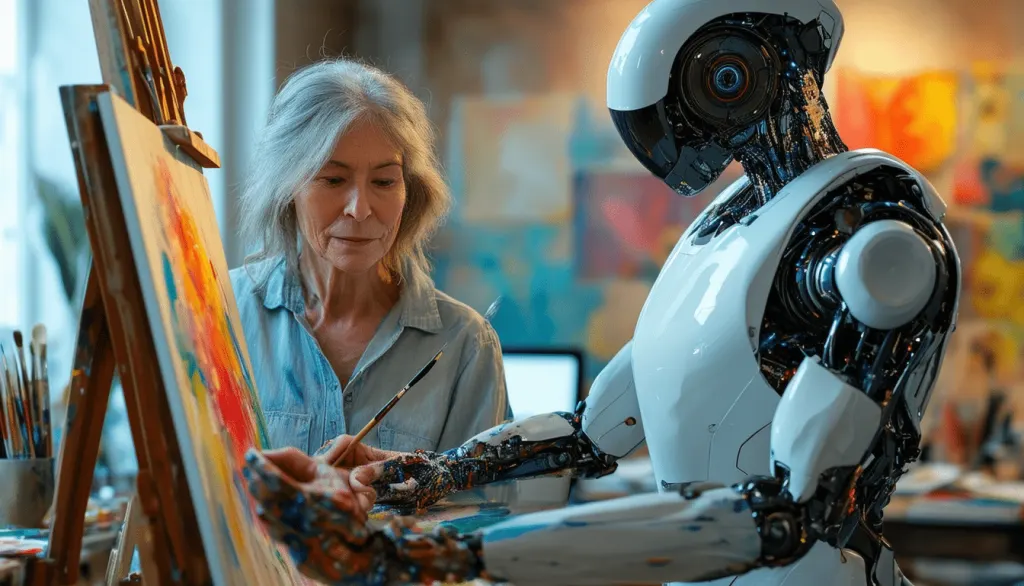
In the field of artistic creation, the**artificial intelligence** opens up fascinating horizons. It presents itself as both an ally and an instrument of innovation for artists, enriching their expression and allowing them to explore previously inaccessible territories. Contrary to the fears surrounding it, AI is not a hindrance but rather an opportunity to rediscover creativity from a new angle, by promoting synergy between art and technology. Taking the form of a powerful tool, it blends into the creative process without replacing the essence and vision of the artist, acting as a vector of inspiration and artistic emancipation.
The introduction of Artificial Intelligence in the artistic field gives rise to numerous debates. Some argue that AI could reduce the value of works of art, while others see it as a promising tool for pushing the boundaries of imagination. This article explores how AI and artists can coexist, creating a creative symbiosis that opens new avenues instead of inhibiting human creativity.
The Transformative Potential of AI in the Artistic World
Since the rise of Artificial Intelligence, artists have explored how these technologies can transform their work. Using AI tools, such as image generators, artists can create works that experiment with new aesthetics and artistic concepts. These automated technologies enable the analysis of large data sets, revealing patterns and structures that were previously inaccessible.
AI: A New Tool, Not a Replacement
Despite fears that AI will replace artists, it is essential to understand that these technologies are tools for human creativity. Like paper and ink, AI is only a means available to artists, and the responsibility for using these tools always lies with humans. AI is not autonomous in its decisions and remains an instrument to amplify and diversify the creative abilities of artists.
The Alliance between Nature and Synthesis
Artists interested in AI often incorporate natural elements into their works by examining how the organic and the synthetic interact. For example, some have used computer vision to capture and analyze images of the natural world, such as water drops observed under a microscope, to inspire creations that explore organic life combined with artificial mechanisms.
Reflection on Digital Practices
Using AI to create artwork also allows artists to reflect on their personal digital practices. By generating models from personal data sets, such as browsing history, artists can question the information they are regularly exposed to and their digital identity. This introspection promotes a better understanding of the impact of digital technology on creativity and daily life.
A Polarized Debate around AI
The discourse around AI remains strongly polarized, between those who fear it and those who love it. Although fears about the devaluation of artistic work are understandable, it is important to remember that it is not the tool, but its use by man that counts. Artists have always demonstrated a great capacity to adapt to new forms of expression, and AI is no exception.
An Influence Already Present in Contemporary Art
Since the 1970s, experiments linking creativity and machines have been carried out in the graphic arts. This integration is only intensifying, with many artists using AI technologies to explore new routes in their works. The arrival of AI does not close the chapter of traditional art, but rather enriches the dialogue between technology and creation.
Notez cet article
Read next
 AI news
Korea Puts a Brake on DeepSeek AI: Should France Follow the Same Path?
The decision of the South Korea to put a brake to the application of DeepSeek raises a burning question: should France…
 AI news
The director of a famous museum encourages artists to integrate artificial intelligence into their creative process
In the world of contemporary art, artificial intelligence is attracting more and more interest. At a famous museum, a…
Intelligence artificielle : Le Caire et Kigali scellent une alliance stratégique
Le Caire et Kigali ont récemment consolidé leur collaboration stratégique dans le domaine de l’ . Cette alliance vise à…
Gouvern. AI : Comment l’Intelligence Artificielle Insuffle une Révolution Créative aux Collectivités
À l'ère de l'intelligence artificielle, les collectivités vivent une transformation profonde. Souvent comparée à un proc