show index hide index
Artificial intelligence (AI) raises many questions about its future and its potential influence on our societies. As machines become more and more sophisticated, questions arise: have they really reached a level of intelligence comparable to humans? Do they have a mind, or even a conscience? AI has already demonstrated impressive capabilities, such as beating the world champion in the game of Go or analyzing immense volumes of data in real time. However, the implications of this technological advance raise intense debates. Some fear possible domination by machines, while others see it as an opportunity for positive transformation for humanity. Understanding the challenges and limits of this evolution is crucial to determining whether artificial intelligence represents a threat or a promise for our future.

Artificial intelligence (AI) has evolved rapidly, from the first automatons to systems capable of beating world champions at complex games. This article seeks to explore the fears and realities around the notion of domination by intelligent machines, asking questions about the consciousness of machines, their economic impacts, and what this means for the future of humanity .
Understanding artificial intelligence
Artificial intelligence is no longer a concept exclusively confined to science fiction stories. It manifests itself today in various applications ranging from voice recognition to the understanding of written texts. Furthermore, advances in Big Data enable the automatic construction of knowledge from large datasets. However, a question remains: do machines have a mind, or even a conscience?
Technological advances and their implications
A major milestone was reached when machines began to outperform humans in areas long considered the preserve of human thought. For example, an artificial intelligence managed to beat the world champion in the game of Go, a game renowned for its strategic complexity. Such events raise crucial questions about the implications of these advances for the future of humanity.
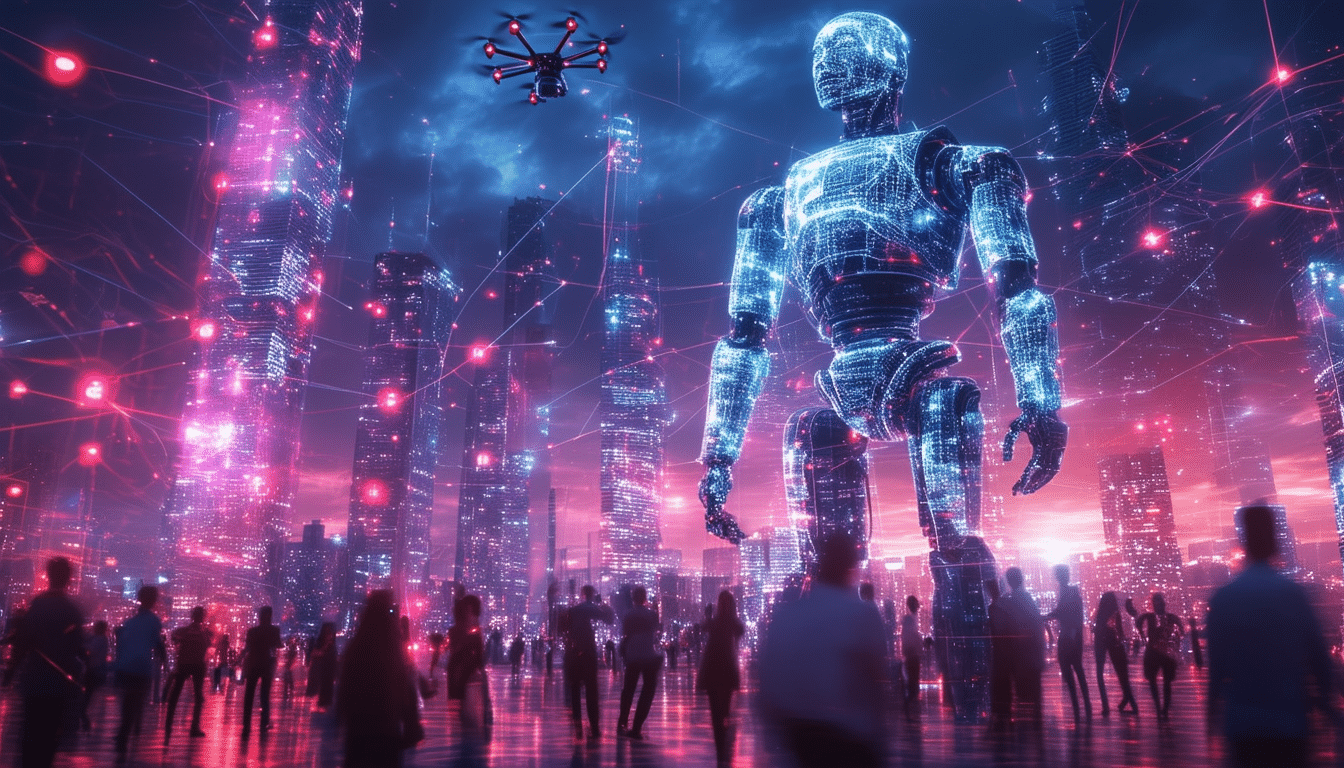
Will robots save us or destroy us?
Jean-Gabriel Ganascia’s work, « Artificial intelligence: towards programmed domination? », addresses head-on the concerns and hopes associated with AI. He wonders about a scenario where machines would surpass human intelligence. Could this then be an era where robots could either save humanity through their enhanced capabilities, or lead us to a form of destruction through loss of control?
The limits of AI capabilities
Despite the impressive advances, it is crucial to understand the current limitations of artificial intelligence. Machines are still far from having a consciousness similar to that of humans. The problem of conscience and moral reasoning remains undeniably human, thus positioning AI as a powerful but not omnipotent tool.
Economic and social impacts
The introduction of AI within various sectors is revolutionizing the concepts of work and productivity. Machines that can learn and adapt can potentially replace millions of jobs, but they can also create new opportunities. This technological renewal calls for a deep reflection on the future labor market, where continuing training and adaptability will be essential.
To read Midjourney V8 Alpha : Révolutionner la création visuelle grâce à l’IA
Business transformation
Companies are increasingly turning to artificial intelligence to optimize their processes. Automation enables more efficient resource management and decision-making based on accurate data analytics. Organizations that adopt AI strategically can gain a significant competitive advantage.
What prospects for the future?
It is indisputable that artificial intelligence is transforming our world. As we continue to develop ever more sophisticated systems, it is essential to remain cautious and thoughtful about the impact of these technologies on our society and our humanity. How will we live in a world where machines are omnipresent and fully intelligent?
Artificial intelligence promises a future full of innovation and transformation. However, for this development to be beneficial, it is crucial to understand its limits and anticipate the challenges it poses. The balance between potential benefits and risks must be carefully managed so that AI becomes a tool at the service of humanity, rather than a vector of domination.