Researchers harness artificial intelligence to unlock the mysteries of nuclear fusion
Contents5
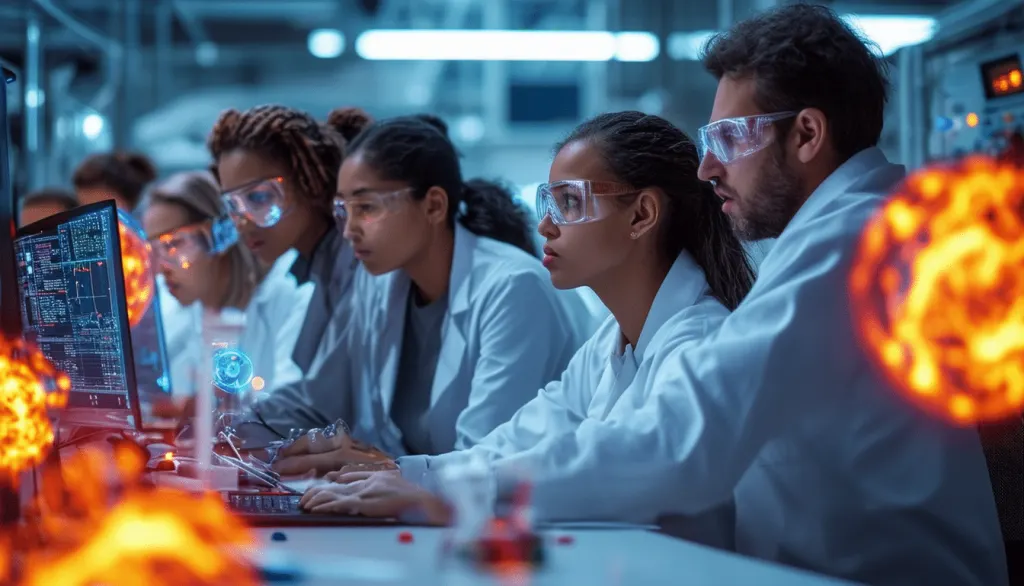
The integration of the**artificial intelligence** in the field of nuclear fusion marks a significant step forward in the quest for clean and inexhaustible energy. Researchers are leveraging this technology to overcome major challenges, such as accurate, real-time measurement of plasma, as well as the prediction of potential instabilities. By improving the stability of reactors and the efficiency of measurements, AI paves the way for a near future where this remarkable source of energy can be exploited for the benefit of all.
Nuclear fusion, long seen as an energy Holy Grail, is getting closer to reality thanks to advances in artificial intelligence. Chinese scientists have taken crucial steps in the development of fusion reactors by using advanced AI techniques to measure and stabilize plasma, a key part of this complex process. Thanks to an increased understanding of plasma behavior, this revolution could enable safer and more efficient exploitation of this clean and virtually inexhaustible energy source.
The transformative impact of AI on nuclear fusion
Research into nuclear fusion, inspired by the sun’s energetic processes, has long been hampered by the difficulty of maintaining plasma at extreme temperatures. However, the use of AI, and in particular neural networks, brings a new dimension to this quest. The ability of AI models to perform complex calculations in real time has taken the understanding of plasma instabilities to the next level.
Advances by Chinese scientists in plasma measurement
Scientists at the Hefei Institute of Physical Sciences in China use neural networks to refine the measurement of plasma in fusion reactors. These algorithms allow accurate pattern recognition and real-time analysis, essential for the success of nuclear fusion. They generate instantaneous data, considerably improving the stabilization and efficiency of reactors.
Using DNN and CNN for fusion
Among the methods used by these researchers, Deep Neural Networks (DNN) and the Convolutional Neural Networks (CNN) stand out for their effectiveness. DNNs perform exponentially faster than traditional techniques while ensuring a high level of accuracy. This speed is essential to obtain vital measurements and stabilize the plasma in real time. As for CNNs, they have demonstrated their ability to accurately predict variations in plasma speed and temperature, thus contributing to its maintenance in optimal conditions.
A promising future for fusion energy
The results observed using these artificial intelligence tools reveal promising potential for fusion energy. The integration of AI in this sector could revolutionize our energy consumption, making clean and sustainable energy accessible to all. AI tools don’t just solve today’s problems; they also lay the foundations for future exploitation of this energy.
Towards total control of fusion energy
The ultimate goal of this research is the complete mastery of nuclear fusion. The intertwining of artificial intelligence and fusion physics offers revolutionary perspectives. Researchers continue to explore this synergy in order to transform nuclear fusion into a viable energy source for future generations, thereby solidifying the foundations of a more sustainable society.
Notez cet article
Read next
 AI news
Nuclear Fusion: The Astonishing Feats of Artificial Intelligence with Plasma That Amaze Researchers
Nuclear fusion, a source of clean and abundant energy inspired by the Sun, intrigues and challenges researchers with…
 AI news
How to unlock Gemini: the complete step-by-step jailbreak guide
In a world where tech giants are deploying increasingly intrusive security systems, unlocking Gemini has become a real c
 AI news
Discover how to unlock the full potential of GPT-5: tips for using it effectively, unlike GPT-4o
You are ready to dive into the fascinating world of GPT 5 ? The transition from GPT 4o has raised many questions, but…
 AI news
Meta opts for nuclear energy to power its artificial intelligence servers
In a bold move, Meta has decided to rely on nuclear energy to meet the growing energy needs of its artificial intelligen