Precipitous stock market plunge: AI causes a $1 trillion loss for tech giants

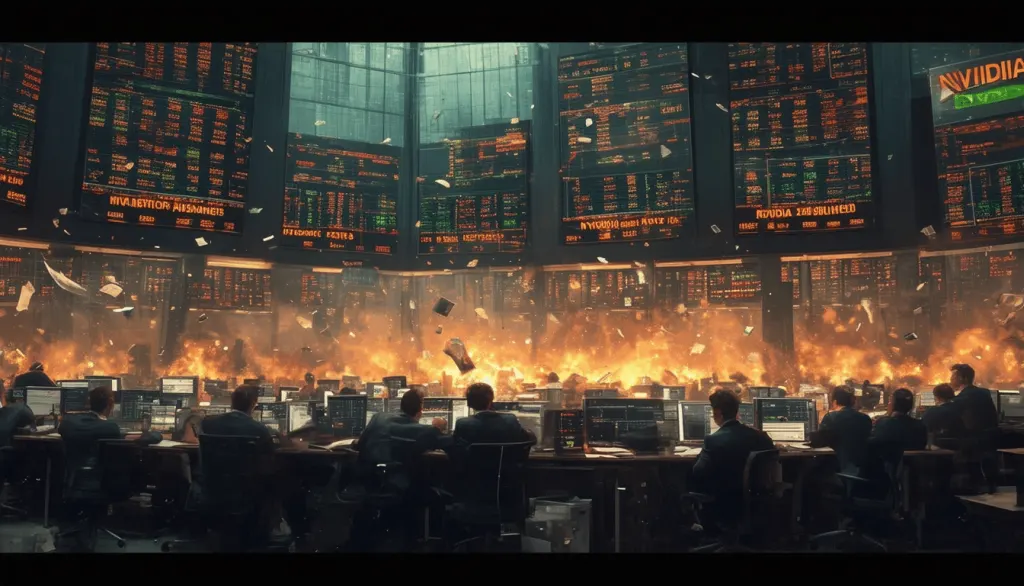
Tech giants are facing a turbulent recession, marked by a precipitous drop in the market capitalization of companies linked to artificial intelligence. In just one week, these companies lost nearly $1 trillion in market capitalization, highlighting the economic stakes associated with the rapid and costly rise of AI. Major players such as Nvidia, Meta, Palantir, and Oracle have all been affected, in a context where Silicon Valley and the global tech market are questioning their investment strategy in the face of emerging challenges. This week, American tech giants, heavily invested in the artificial intelligence sector, suffered colossal losses on the stock market. AI-related companies recorded a cumulative loss of nearly $1 trillion in market capitalization. Nvidia, Meta, Palantir, and Oracle are among the hardest hit, causing a drop in the Nasdaq Composite index. Meanwhile, concerns are mounting about the economic slowdown in the United States, exacerbated by government paralysis. This article explores the reasons for this precipitous fall and the dynamics influencing the current technology market. Impact of AI on the Stock Market American companies involved in the development of artificial intelligence have experienced a drastic loss in their stock market value. Between late October and early November, the market capitalization of these companies fell by approximately $800 billion. Nvidia was particularly hard hit, registering the largest decline in market capitalization, to around $350 billion.This decline is attributed to various factors, including the evolution of investment spending in AI, which is substantial and often financed by debt. A diagram reminiscent of a bubbletechnological boom of the 2000s. Significant financial commitments from companies like Alphabet, Amazon, Meta, and Google, with investments totaling $112 billion in the third quarter, reflect this trend. Economic Factors Influencing Markets **Concerns are not limited to the performance of technology companies. The slowdown in the U.S. labor market and low consumer confidence are adding to market volatility. The University of Michigan’s consumer confidence index has reached its lowest level in three years, fueling fears of a potential economic recession.**To make matters worse, the U.S. federal government shutdown is blocking the release of key economic data, injecting even more uncertainty into financial markets. Hiring rates, measured by the Federal Reserve Bank of Chicago, have declined for the sixth consecutive month, exacerbating concerns about the health of the U.S. economy. Geopolitical Context and Future Prospects On the international stage, competition between the United States and China in the field of AI is intensifying. Chinese companies continue to make rapid progress, narrowing the technological gap. Moonshot AI’s Kimi K2 model, developed at a relatively low cost in Beijing, is a testament to this advancement. Nvidia CEO Jensen Huang even believes that China could overtake the United States in the AI race. Despite this foreign competition, some American companies, such as OpenAI, are seeking solutions to remain at the forefront of innovation without relying on government support. Sam Altman, its CEO, anticipates high revenues by 2030, despite current challenges.
Notez cet article
Read next
 AI news
The collapse of Nvidia: A loss of 280 billion on the stock market which plunges the market
The stock market collapse of Nvidia constitutes an unprecedented event, leading to a loss of nearly $280 billion in…
 AI news
Who will win the battle of the artificial intelligence giants: Nvidia or Arm Holdings? Discover the best stock to invest in!
In the ever evolving field of , giants Nvidia and Arm Holdings are vying for the top spot. But the question remains:…
 AI news
AI is making its way onto the stock market: analysis by Marc Fiorentino
is playing an increasingly central role in the world of finance, creating significant turmoil on Wall Street. Companies…
 AI news
The stock market: the reasons for the revival of American technology
The US stock market, after a period of turbulence, is seeing renewed interest in the technology sector. Technology…